
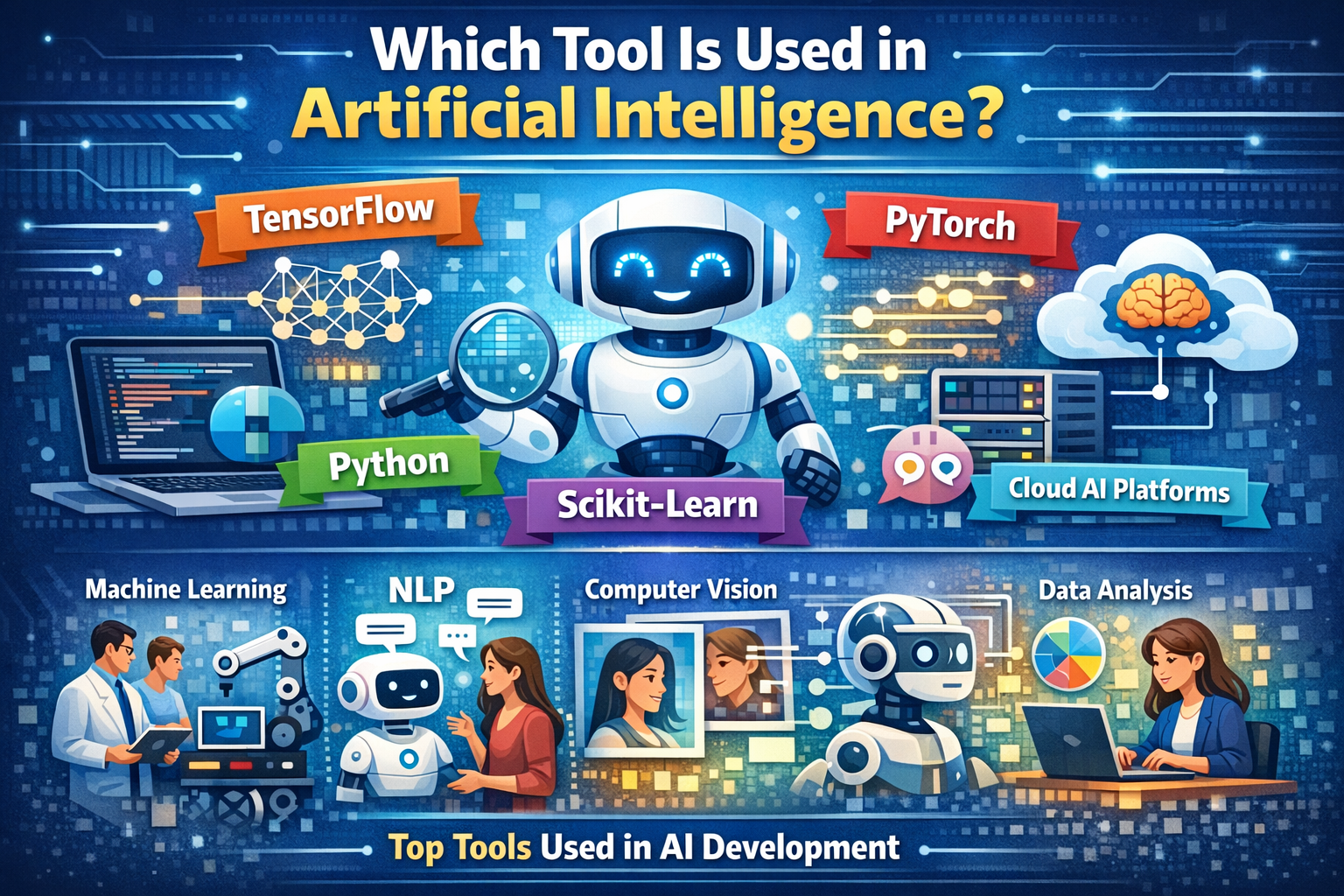
Artificial Intelligence is growing very fast in today’s digital world. Many people want to know which tool is used in artificial intelligence and how these tools help in building smart systems. Artificial intelligence tools are software, frameworks, and platforms that help developers create machines that can learn, think, and make decisions. These tools make it easier to build applications like chatbots, recommendation systems, voice assistants, and image recognition systems. When we discuss which tool is used in artificial intelligence, it is important to understand that different tools are used for different tasks such as machine learning, deep learning, natural language processing, and computer vision.
Artificial intelligence development has become easier because many powerful platforms are available today. Developers no longer need to build everything from scratch. Instead, they use libraries and frameworks that already contain useful algorithms and models. When someone asks which tool is used in artificial intelligence, the answer usually includes programming languages, machine learning libraries, and development environments. These tools help programmers train models, test them, and deploy them into real applications. With the right tools, even small teams can build intelligent systems that were once possible only for large technology companies.
One of the most common answers to which tool is used in artificial intelligence is Python. Python is the most popular programming language for AI development. It is simple to learn, easy to read, and has a large community of developers. Python supports many AI libraries such as TensorFlow, PyTorch, and Scikit-learn. Because of these libraries, developers can easily create machine learning models and analyze large amounts of data. Python also works well with data science tools, which makes it perfect for building AI systems that require data analysis and prediction.
Another important tool when discussing which tool is used in artificial intelligence is TensorFlow. TensorFlow is an open-source machine learning framework created by Google. It is widely used for deep learning projects. TensorFlow allows developers to build neural networks that can recognize images, understand speech, and even translate languages. Many companies use TensorFlow because it is powerful and scalable. It also supports both research and production environments, which means developers can experiment with ideas and then deploy them in real-world applications.
PyTorch is another popular answer to the question which tool is used in artificial intelligence. PyTorch is a deep learning framework developed by Meta. It is especially popular among researchers and students because it is flexible and easy to use. PyTorch allows developers to build neural networks quickly and test new ideas without complex setup. Many modern AI models are created using PyTorch because it supports dynamic computation graphs, which make experimentation easier. This flexibility makes PyTorch one of the most loved tools in the AI community.
When people ask which tool is used in artificial intelligence, Scikit-learn is also an important name. Scikit-learn is a machine learning library for Python that provides many algorithms for classification, regression, clustering, and data analysis. It is often used for beginner and intermediate AI projects. Scikit-learn is easy to learn and very well documented. Developers can train machine learning models with just a few lines of code. This makes it perfect for building predictive models, recommendation systems, and data analysis applications.
Another useful tool when exploring which tool is used in artificial intelligence is Keras. Keras is a high-level neural network library that runs on top of TensorFlow. It is designed to make deep learning easier for developers. With Keras, developers can build complex neural networks with simple and clean code. Many beginners prefer Keras because it removes much of the complexity of deep learning development. It is widely used for tasks such as image recognition, text analysis, and speech processing.
Data processing is also very important when discussing which tool is used in artificial intelligence. Tools like Pandas and NumPy help developers handle and analyze large datasets. AI models need a lot of data to learn patterns, and these tools make it easier to clean, organize, and process that data. Without proper data processing tools, building AI systems would be very difficult. Pandas allows developers to work with structured data, while NumPy helps with mathematical operations and numerical computing.
Cloud platforms are also part of the answer to which tool is used in artificial intelligence. Services like Google Cloud AI, Microsoft Azure AI, and Amazon Web Services provide ready-to-use AI tools and infrastructure. These platforms allow developers to train machine learning models without needing expensive hardware. They also offer pre-built services such as speech recognition, image analysis, and chatbot development. Cloud AI platforms make artificial intelligence accessible to startups, businesses, and individual developers.
Another important category when asking which tool is used in artificial intelligence is natural language processing tools. NLP tools help machines understand and generate human language. Libraries such as NLTK and spaCy are widely used for text analysis and language processing. These tools are used to build chatbots, sentiment analysis systems, and language translation applications. NLP tools are becoming more important because many modern applications depend on understanding human language.
Computer vision tools are also a big part of the discussion about which tool is used in artificial intelligence. Computer vision allows machines to understand images and videos. Libraries like OpenCV are commonly used for this purpose. OpenCV helps developers build applications such as facial recognition systems, object detection systems, and image classification models. These technologies are used in many industries including healthcare, security, and self-driving cars.
AI development environments are also important when learning which tool is used in artificial intelligence. Tools such as Jupyter Notebook and Google Colab help developers write and test AI code easily. These platforms allow programmers to combine code, text, and visualizations in one place. Google Colab also provides free access to GPUs, which makes it easier to train deep learning models. These environments are widely used by students, researchers, and professional developers.
In conclusion, understanding which tool is used in artificial intelligence helps us see how AI systems are built and developed. Artificial intelligence tools include programming languages, machine learning frameworks, data processing libraries, and cloud platforms. Popular tools such as Python, TensorFlow, PyTorch, Scikit-learn, and Keras play a major role in AI development. At the same time, tools for data analysis, natural language processing, and computer vision help create powerful intelligent systems. As technology continues to grow, new tools will continue to appear, making artificial intelligence easier and more powerful for developers around the world.
Chart: Popular AI Programming Languages
| Language | Why It Is Used in AI | Difficulty Level |
|---|---|---|
| Python | Easy to learn and powerful libraries | Easy |
| R | Good for statistics and data analysis | Medium |
| Java | Good for large enterprise AI systems | Medium |
| C++ | High performance for complex AI systems | Hard |
Chart: Popular Machine Learning Frameworks
| Framework | Main Use | Popularity |
|---|---|---|
| TensorFlow | Deep learning models | Very High |
| PyTorch | Research and flexible models | Very High |
| Scikit-learn | Traditional machine learning | High |
| Keras | Beginner friendly deep learning | High |
Chart: AI Data Processing Tools
| Tool | Purpose | Key Feature |
|---|---|---|
| Pandas | Data cleaning and analysis | Easy data handling |
| NumPy | Numerical computing | Fast calculations |
| Matplotlib | Data visualization | Graphs and charts |
| Seaborn | Statistical visualization | Beautiful graphs |
Chart: AI Cloud Platforms
| Platform | Provider | Main Benefit |
|---|---|---|
| Google Cloud AI | Powerful AI services | |
| Azure AI | Microsoft | Enterprise AI tools |
| AWS AI | Amazon | Scalable infrastructure |
| IBM Watson | IBM | Business AI solutions |
Chart: AI Application Areas
| AI Area | Example Use | Industry |
|---|---|---|
| Natural Language Processing | Chatbots | Customer service |
| Computer Vision | Facial recognition | Security |
| Machine Learning | Prediction systems | Finance |
| Robotics | Smart robots | Manufacturing |