

Understanding 3 Types of Artificial Intelligence with Examples
Artificial Intelligence is changing the world in many ways. People often hear about AI, but understanding its types is important for beginners. Knowing the main categories helps you understand how machines can perform tasks that usually require human intelligence. There are different AI systems, each designed for specific purposes.
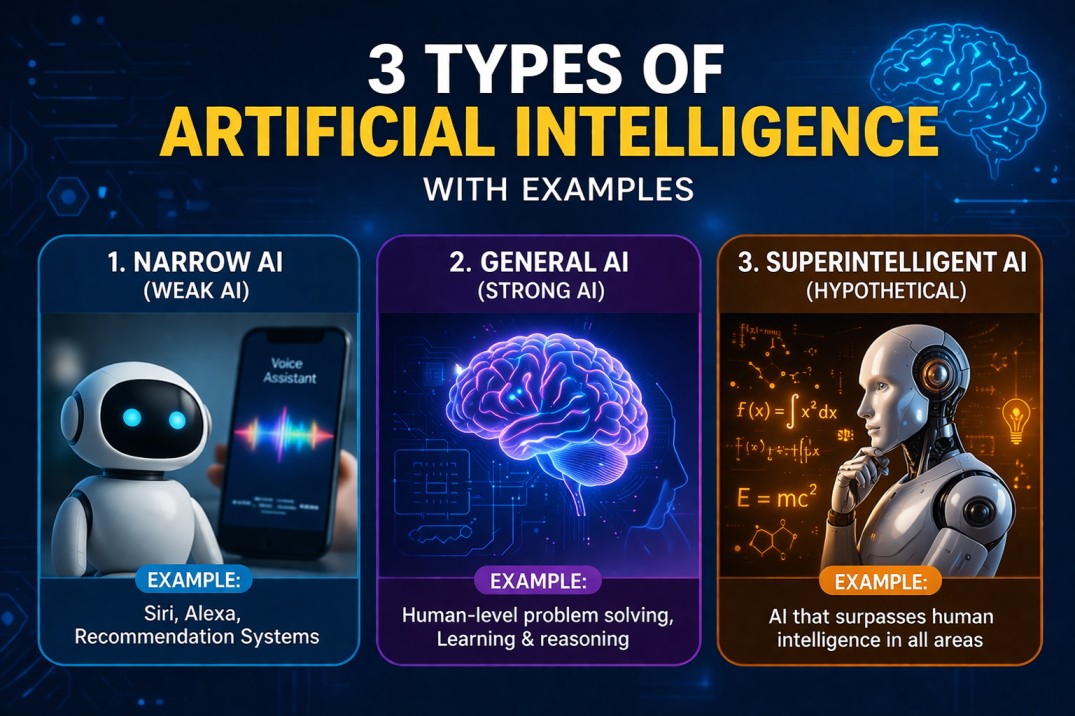
The first type of AI is Narrow AI. This AI focuses on a single task. For example, voice assistants like Siri or Alexa perform very specific tasks like setting reminders or answering questions. Narrow AI cannot perform tasks beyond its programming, but it is very effective at what it is designed to do.
The second type is General AI. General AI can perform multiple tasks like a human being. It can understand, learn, and apply knowledge in different areas. This type of AI is still largely theoretical, but researchers are working to create systems that can think and solve problems like humans.
The third type is Super AI. Super AI is more advanced than human intelligence. It can outperform humans in all areas, including creativity and decision-making. Currently, Super AI does not exist, but it is a concept that guides future research in artificial intelligence.
Understanding 3 types of artificial intelligence with examples helps beginners and students learn how AI is categorized. Narrow AI, General AI, and Super AI are the main types. Examples like Siri for Narrow AI and theoretical models for General and Super AI make the concept easier to understand.
Narrow AI is used in daily life more than most people realize. Applications like chatbots, recommendation systems, and image recognition are all Narrow AI. These systems work within a defined range but provide real value in technology and business.
General AI aims to replicate human-like thinking. Researchers design these systems to learn from multiple sources and apply knowledge creatively. Unlike Narrow AI, General AI can handle unfamiliar tasks without specific programming.
Super AI represents the future of technology. It is imagined as a system that can surpass human intelligence in every way. Though it does not exist yet, discussions about Super AI focus on ethics, safety, and how it could impact society.
Many professionals and students find it useful to study 3 types of artificial intelligence with examples. Knowing real-life examples makes AI less confusing. Students can see how AI affects business, healthcare, transportation, and daily life.
Learning about Narrow AI applications also shows how AI helps businesses. For example, online shopping websites use AI to suggest products based on past behavior. This improves customer experience and increases sales without human effort.
General AI research continues in laboratories around the world. AI systems are being developed to understand natural language, perform complex tasks, and even make decisions. Though practical General AI is not yet available, its development is accelerating quickly.
Super AI is a popular topic in science fiction and academic discussions. Experts imagine that Super AI could solve problems faster than humans and create innovations that are impossible today. Ethical and safety considerations are crucial in this area.
Explaining 3 types of artificial intelligence with examples in simple terms helps everyone, from beginners to professionals, understand AI’s potential. By breaking down the concepts and giving real-world examples, AI becomes less intimidating.
One of the best examples of Narrow AI is autonomous vehicles. These cars can drive themselves using sensors, cameras, and programmed instructions. However, they cannot perform tasks outside their specific design.
General AI would include systems capable of learning multiple languages, solving math problems, and making creative decisions. Though not yet fully realized, it is a goal for AI researchers worldwide.
Super AI remains hypothetical but provides an inspiring goal. Imagine a system that can manage complex global problems, invent new technologies, and make decisions that improve society as a whole.
Students and professionals often create projects to explore 3 types of artificial intelligence with examples. These projects include working with chatbots, analyzing data with AI software, or simulating General AI behavior. Hands-on experience helps in understanding AI better.
Finally, understanding these AI types helps in planning careers in technology. Knowledge of Narrow, General, and Super AI can guide students and professionals toward fields like machine learning, robotics, or AI ethics.
Narrow AI Examples
| Application | Function |
|---|---|
| Voice Assistants | Answer questions, set reminders |
| Image Recognition | Identify objects in photos |
| Recommendation Systems | Suggest products or media |
| Chatbots | Provide customer service |
General AI Examples
| Application | Function |
|---|---|
| Language Processing AI | Translate languages, understand text |
| Decision-making AI | Analyze data, solve complex problems |
| Creative AI | Generate art, music, or designs |
Super AI Concepts
| Concept | Potential Use |
|---|---|
| Global Problem Solving | Manage resources, energy, and climate |
| Scientific Innovation | Create new technologies and medicines |
| Decision Optimization | Make high-level decisions for society |
AI in Daily Life
| Area | Example |
|---|---|
| Healthcare | AI assists in diagnosis and treatment |
| Transportation | Self-driving cars and navigation AI |
| Business | Marketing AI and sales prediction |
| Education | Personalized learning software |
AI Research Focus
| Type | Current Goal |
|---|---|
| Narrow AI | Improve specific task performance |
| General AI | Create human-like reasoning |
| Super AI | Develop advanced intelligence safely |